


To start off, I’m a total Macca fan-boy… so beware!
At just now 84, Paul McCartney has nothing left to prove.
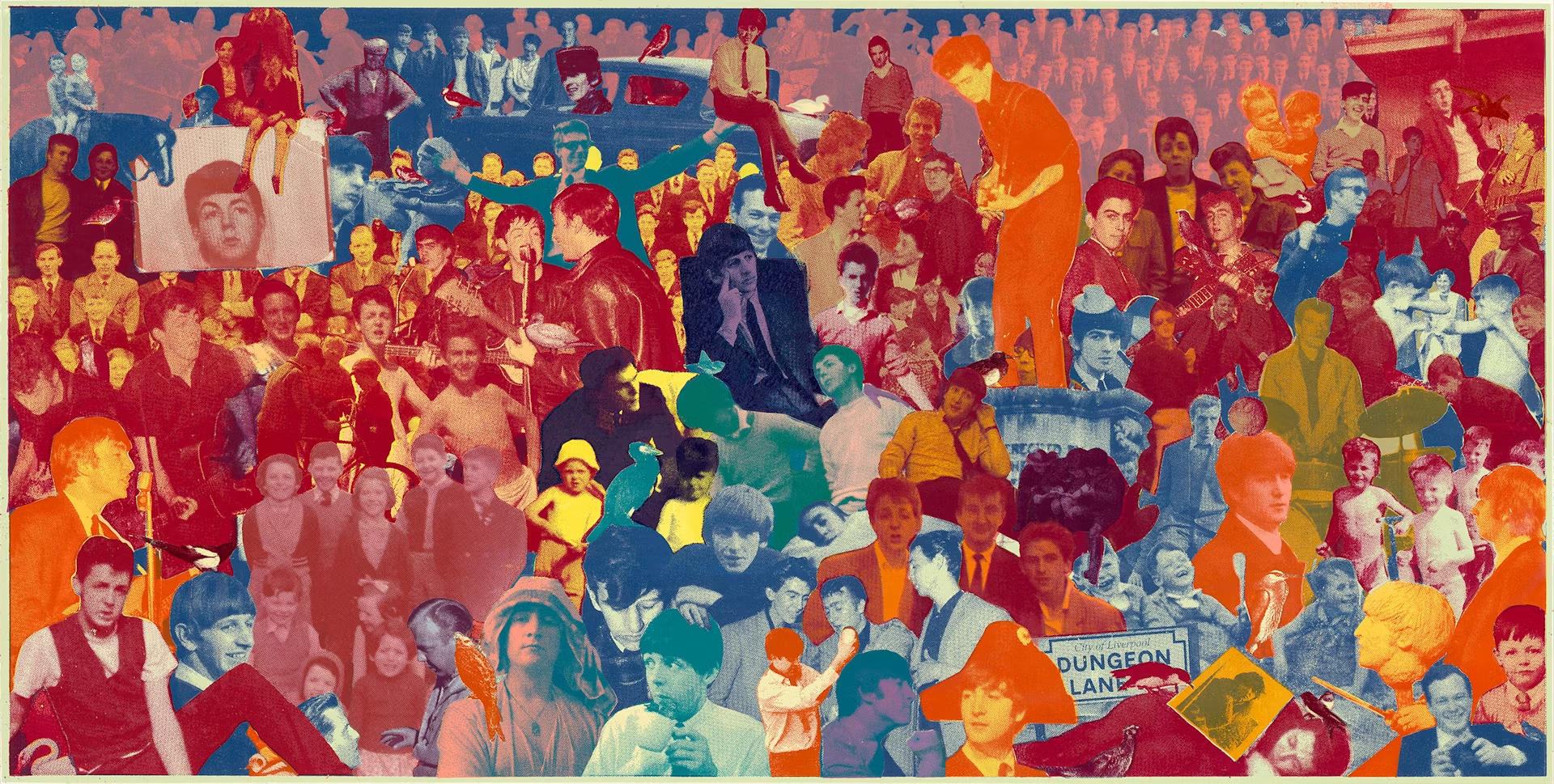
That’s exactly what makes The Boys of Dungeon Lane, his twentieth solo studio album, land as hard as it does. Released May 29, 2026, and co-produced with Andrew Watt, this is McCartney’s first solo record in roughly five years — and by a wide margin, his most personal for a while.
Where he’s spent a career slipping into other people’s stories, here he finally turns the lens on his own: post-war Liverpool, his parents, and the friendships with George Harrison and John Lennon that existed long before anyone had heard the word “Beatlemania.” The album takes its title from a real street in Speke, the working-class Liverpool suburb where McCartney grew up — and from a lyric buried in a demo he wrote back in 1991. That’s the record in miniature: something old, rediscovered and made new again.
A Tale of Two Halves

Musically, Dungeon Lane doesn’t sit still. There’s Wings-style rock, Beatles-era harmony, hushed McCartney balladry, and character sketches, all held together by a voice that’s rougher around the edges now but unmistakably his. True to form for a man who made most of McCartney (1970) on his own, he plays the bulk of the instruments here himself.
“As You Lie There” opens the album with a sleight of hand — a spoken, wistful memory of a childhood crush (apparently named Jasmine) he never worked up the nerve to approach (“I used to walk past your house. Every night, I’d look up at your window. The light was on. I saw your silhouette on the blind. Do you think of me?” ) — before the song suddenly detonates into a full-throated rocker. (“As you lie across the bed. Am I there inside your head? As you lie there. As you lie there.”) It’s a mission statement: nostalgia is the entry point, not the whole story. And it’s brilliant.
“Lost Horizon” follows, a genuine relic — a song from the 2000s that had been lost entirely until his engineer dug it up. It’s about how the smallest sounds (a train whistle, an idling car, kids in a playground) can yank you straight back into memory, and it lands on an unfussy, hard-won piece of wisdom: live for now.

Then comes “Days We Left Behind,” the lead single and the album’s emotional spine — a bare acoustic ballad, stripped of drums, about impermanence and the pull of the past, tied to his old street and his bond with Lennon. It’s the song most likely to be remembered from this record in twenty years, with its beautiful, wistful chorus: “‘Cause nothing stays the same. And no one needs to cry. No one is to blame. For the days we left behind”.
“Ripples in a Pond” lightens the mood, a chiming love song reportedly written for his wife, Nancy Shevell — less about falling in love than about a relationship that keeps deepening. (“I love you more than I ever did before. The feeling grows and grows. Let’s carry on making ripples in a pond. And we’ll see how far it goes”).
“Mountain Top” swings hard the other way: inspired by his own Glastonbury headline set, it’s the most psychedelic thing here, tape loops and all, sketching a young festival-goer mid-trip with a wink back to Sgt. Pepper, with lyrics like “Pumpkin pies in the skies. Also try to hypnotize. You and me everywhere we go.”
The Ghosts of the Beatles
The back half of the album’s first act is where the record’s stakes are clearest. “Down South” is a quiet, acoustic recollection of hitchhiking with George Harrison as teenagers — and given how strained that friendship became in later years, its warmth carries real weight. The Beatles references are dense in the chorus: “It was a good way to get to know you. A fine way to work it all out. It was a good way to get to know you. Before we learned to twist and shout. Oh, yeah, oh, yeah…”
“We Two” goes further, recorded on an old four-track machine the Beatles themselves once used, closing out in tape-loop textures that feel like a direct nod to “Two of Us.”
“Come Inside” breaks the spell briefly with straightforward guitar swagger.
“Never Know” brings back a “Fool on the Hill”-style recorder line — one of the more divisive tracks among early listeners, either a highlight or a minor dip depending on who you ask.

“Home to Us” is the record’s marquee moment: McCartney’s first true duet with Ringo Starr, a warm look back at a shared, poor-but-happy past. Hearing the two surviving Beatles sing together, this late in both their lives, gives the song a weight no lyric sheet could carry on its own.
Coming Home to His Parents
The album saves its most affecting turn for last. “Life Can Be Hard” and “First Star of the Night” settle into a wearier, wiser register — the latter drawing comparisons to the guitar tone of “Dear Prudence.” Then “Salesman Saint” arrives as a horn-driven, almost mariachi-tinged tribute to his parents: his father cast as the hardworking “salesman,” his mother as the “saint,” with a swing-jazz break that nods to his father’s own background as a jazz musician.
The album closes with the lovely “Momma Gets By,” a spare, piano-led character study of a working-class mother holding a difficult marriage together. It’s not judgmental, just clear-eyed — and it’s a fitting final note for a record that spends its runtime looking for the people who shaped McCartney before the world ever got to. It has lyrics beginning as, “Momma gets by while papa gets high. She makes enough to raise a family. She’s working all day to bring in the pay. She’s taking good care of me Giving me every opportunity”.
It’s McCartney at his stripped-down and personal best.
The Verdict
The Boys of Dungeon Lane doesn’t reinvent McCartney so much as it excavates him. It’s a 47-minute, 14-track record that trades the character songs and studio experimentation of his more restless years for something plainer and more exposed: an old man remembering the boy he was, the friends he lost, and the parents who made the rest of it possible.
In my opinion, it’s a warm, unguarded late-career highlight — and one well worth the wait.
Chris Garrod, July 12, 2026
Rating: 9.5/10.0
Buy here: https://shopuk.paulmccartney.com
